

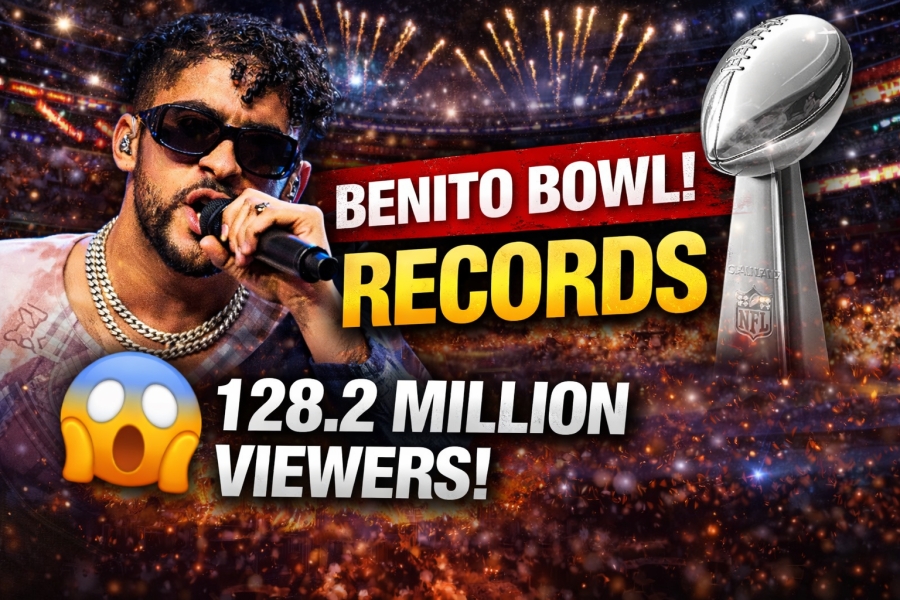
Bad Bunny’s Super Bowl Halftime Show Breaks Records: The Rise of the “Benito Bowl”
When Bad Bunny stepped onto the Super Bowl halftime stage, it was already clear the moment would be historic. What nobody fully anticipated was just how massive it would become.
By the time the lights dimmed and the final beat dropped, the numbers told a staggering story: 128.2 million viewers tuned in to watch Bad Bunny’s halftime show, officially making it one of the most-watched halftime performances in NFL history. Almost instantly, fans and media gave it a new name — the “Benito Bowl.”
Beyond TV ratings, the performance detonated across social media, breaking engagement records, dominating trending lists, and reshaping what a Super Bowl halftime show can look like in the modern era.
This wasn’t just a performance. It was a cultural shift.
The Viewership Numbers That Shocked the NFL
The Super Bowl has always been the biggest stage in American entertainment, but Bad Bunny’s halftime show pushed that scale even further.
According to official broadcast data, the halftime show attracted 128.2 million viewers, putting it firmly in the top tier of all-time Super Bowl halftime performances. That figure doesn’t just represent football fans — it reflects a global audience spanning Latin America, Europe, and beyond.
What makes the number even more impressive is the context:
-
Viewership fragmentation is at an all-time high
-
Younger audiences increasingly consume content via clips, not live TV
-
Music performances rarely pull audiences larger than the game itself
And yet, Bad Bunny’s halftime show matched and, in some moments, surpassed the game’s peak viewership.
In an era where live television struggles to hold attention, this was a rare exception.
Why the “Benito Bowl” Hit So Differently
The nickname didn’t come from nowhere. Fans quickly realized this halftime show wasn’t designed to play it safe — it was designed to be authentically Bad Bunny.
Rather than tailoring his performance to traditional NFL expectations, Bad Bunny leaned into:
-
Spanish-language hits
-
Caribbean rhythms
-
Reggaeton, trap, and Latin pop fusion
-
Visual storytelling is rooted in his culture
That decision paid off.
For many viewers, this was the first Super Bowl halftime show that felt truly global, not just American. It reflected how music consumption has changed — streaming platforms have erased borders, and artists like Bad Bunny now dominate charts worldwide without ever switching languages.
The “Benito Bowl” wasn’t about compromise. It was about confidence.
Social Media Engagement Records Were Shattered
While the TV ratings were headline-worthy, the social media response told an even bigger story.
Within minutes of the halftime show ending:
-
Bad Bunny trended worldwide across multiple platforms
-
Halftime-related hashtags dominated X (Twitter), TikTok, and Instagram
-
Clips from the performance generated millions of views in hours
According to early analytics, the show broke Super Bowl halftime engagement records, surpassing previous viral benchmarks set by artists like Rihanna, Beyoncé, and Shakira.
Fans weren’t just watching — they were reacting, remixing, debating, and celebrating in real time.
This is where the “Benito Bowl” truly separated itself: it wasn’t a one-night event. It became a multi-day digital phenomenon.
A Landmark Moment for Latin Music on the World’s Biggest Stage
Bad Bunny’s Super Bowl halftime show wasn’t just successful — it was symbolic.
For decades, Latin artists were either excluded from the halftime stage or expected to dilute their sound to appeal to a broader audience. This performance flipped that narrative entirely.
Bad Bunny performed largely in Spanish, without apology or explanation, in front of one of the biggest live audiences on the planet. And instead of alienating viewers, it drew record-breaking numbers.
That sends a powerful message to the music industry:
global audiences are ready — and eager — for authentic representation.
This wasn’t a crossover moment. It was a takeover.
How Bad Bunny Redefined the Super Bowl Halftime Formula
Traditionally, Super Bowl halftime shows follow a familiar formula:
-
Medley of the biggest English-language hits
-
Broad, family-friendly visuals
-
Safe choices designed to offend as few people as possible
Bad Bunny’s performance challenged that model.
Instead of nostalgia or greatest-hits fan service, the show focused on energy, movement, and cultural identity. It felt closer to a world-class festival performance than a legacy act showcase.
The result?
Younger viewers stayed engaged. International audiences tuned in. And the NFL benefited from relevance that extended far beyond the United States.
It was a calculated risk — and it paid off.
The Backlash Only Fueled the Conversation
No Super Bowl halftime show escapes criticism, and the “Benito Bowl” was no exception.
Some critics complained about:
-
The use of Spanish during a national broadcast
-
The departure from traditional halftime expectations
-
The political and cultural undertones of the performance
But rather than hurting the show’s impact, the backlash amplified it.
Every critique sparked a counter-reaction. Fans defended the performance passionately, turning debates into viral moments and pushing engagement even higher.
In the attention economy, controversy often equals visibility — and the numbers prove it worked.
Streaming Numbers Surge After the Halftime Show
As expected, Bad Bunny’s streaming numbers surged immediately following the Super Bowl.
Within hours:
-
Multiple songs featured in the halftime show climbed global charts
-
Catalog streams spiked across major platforms
-
New listeners discovered his music for the first time
This “halftime effect” isn’t new, but the scale this time was remarkable. The performance didn’t just boost one or two tracks — it reignited interest across Bad Bunny’s entire discography.
For the NFL, this reinforced the value of partnering with artists who dominate streaming culture, not just radio.
What the “Benito Bowl” Means for the Future of the Halftime Show
Bad Bunny’s record-breaking performance may end up being a turning point for Super Bowl halftime shows moving forward.
Here’s what it signals:
Global Artists Are No Longer a Risk
The success of a primarily Spanish-language performance proves that global stars can deliver massive ratings without watering down their identity.
Social Media Matters as Much as TV Ratings
Engagement, clips, and cultural conversation now define success as much as viewership numbers.
Authenticity Beats Nostalgia
Audiences responded to a show that felt current, alive, and rooted in real culture — not just past hits.
Future halftime performers will almost certainly be measured against the “Benito Bowl” standard.
A Super Bowl Performance That Will Be Remembered
Years from now, Bad Bunny’s Super Bowl halftime show will likely be remembered not just for its numbers, but for what it represented.
It was:
-
A cultural milestone
-
A validation of Latin music’s global dominance
-
A redefinition of what the Super Bowl halftime stage can be
With 128.2 million viewers and record-shattering social media engagement, the “Benito Bowl” didn’t just break records — it broke expectations.
And in doing so, it cemented Bad Bunny’s place not just as a chart-topping artist, but as one of the most influential performers of his generation.
