

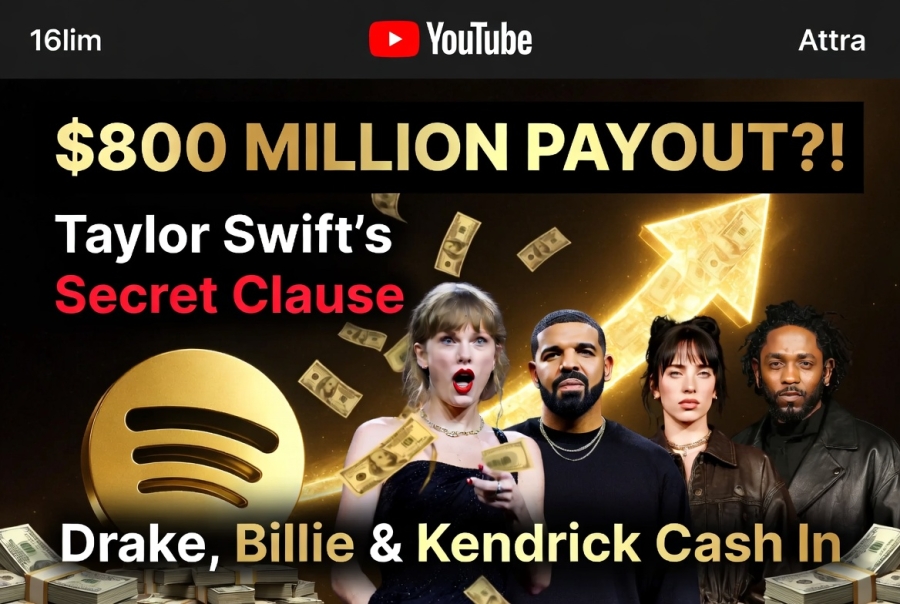
Taylor Swift’s Record Deal Clause Could Unlock $800M for Artists: A Turning Point for the Music Industry
The global music industry may be on the brink of one of its most significant financial shifts in years—and it all connects back to Taylor Swift.
Recent reports suggest that a clause tied to her record deal could trigger between $500 million and $800 million in payouts to artists if Universal Music Group sells its shares in Spotify.
If confirmed and executed, this would mark a major redistribution of streaming-era wealth—potentially benefiting global superstars like Drake, Billie Eilish, and Kendrick Lamar.
But this isn’t just about a massive payout.
This story goes much deeper.
It touches on artist rights, streaming economics, label power, and the future of how music revenue is shared.
Let’s break it all down.
What Is the Taylor Swift Clause?
At the center of this story is a reportedly negotiated clause tied to Taylor Swift’s agreement with Universal Music Group.
While exact contract details remain private, industry insiders suggest that the clause ensures that if Universal profits from selling its Spotify shares, a portion of that profit must be shared with artists.
That’s a big deal.
Why?
Because historically, artists have not always benefited directly from label-level investments—especially when it comes to equity stakes in platforms like Spotify.
This clause flips that dynamic.
Instead of labels keeping the upside from equity deals, artists could now receive a share of that value.
And we’re not talking small numbers.
We’re talking hundreds of millions.
Where Does the $800 Million Figure Come From?
The estimated $500M–$800M payout range comes from projections tied to the value of Universal’s stake in Spotify.
Labels like Universal Music Group were early investors in streaming platforms as part of licensing deals during the early days of digital music.
Over time, those shares have become extremely valuable.
If Universal chooses to sell part or all of its stake, the profits could be enormous.
And thanks to this clause, a portion of that money may flow directly to artists.
That’s why this story is getting so much attention.
It represents a rare moment where artists could benefit from the financial side of streaming infrastructure—not just royalties.
Why This Matters for Artists
For years, one of the biggest criticisms of the streaming era has been how revenue is distributed.
Artists often earn fractions of a cent per stream, while platforms and labels generate significantly larger returns.
This potential payout changes the conversation.
1. Artists Could Share in Platform Wealth
Instead of only earning from streams, artists could now benefit from:
- equity deals
- platform growth
- long-term investment value
That creates a new financial layer in music careers.
2. It Sets a New Standard for Record Deals
If this clause proves successful, other artists may demand similar terms in their contracts.
That could reshape negotiations across the industry.
Labels may need to:
- share more profits
- offer better transparency
- rethink long-term revenue structures
3. It Strengthens Artist Bargaining Power
Artists are already gaining leverage thanks to:
- social media independence
- direct-to-fan platforms
- global streaming access
Now, financial clauses like this add another layer of power.
Taylor Swift’s Long History of Fighting for Artists
This development is not surprising when you look at Taylor Swift’s track record.
She has consistently pushed for:
- artist ownership
- fair compensation
- control over master recordings
- Better treatment from streaming platforms
From removing her catalog from Spotify in the past to re-recording her albums to regain ownership, Swift has built a reputation as one of the most business-savvy artists in the world.
This clause fits that pattern perfectly.
It shows she is not just thinking about her own career—but about industry-wide impact.
Which Artists Could Benefit?
If this payout happens, it wouldn’t just affect one or two artists.
It could impact a wide range of major names signed under Universal Music Group.
Potential beneficiaries include:
- Drake
- Billie Eilish
- Kendrick Lamar
And potentially many more.
Depending on how the clause is structured, payouts could be distributed based on:
- catalog value
- streaming performance
- contract terms
- label agreements
The exact mechanics are still unclear.
But the scale is undeniable.
The Bigger Issue: Streaming Economics
This story highlights a deeper issue:
Who really profits from streaming?
Streaming platforms like Spotify have transformed how music is consumed.
But they have also created ongoing debates around:
- artist payouts
- revenue distribution
- platform power
- algorithmic influence
Artists generate the content.
Platforms distribute it.
Labels manage rights.
But the financial balance between these players has always been uneven.
This potential payout could help rebalance that.
Will This Change the Industry?
Possibly.
But not overnight.
Here’s what could happen next:
1. More Artist-Friendly Contracts
Artists—especially at the top level—may begin negotiating:
- equity participation clauses
- profit-sharing agreements
- transparency requirements
2. Increased Pressure on Labels
Labels may face pressure to:
- disclose financial structures
- justify revenue splits
- offer more competitive deals
3. Greater Focus on Ownership
Artists are already prioritizing ownership of:
- masters
- publishing rights
- brand identity
This trend will only accelerate.
Why Independent Artists Should Pay Attention
Even if you’re not signed to Universal Music Group, this still matters.
Because industry changes at the top eventually influence the entire ecosystem.
Independent artists can learn from this moment:
Build Long-Term Value
Think beyond streams.
Think about:
- catalog ownership
- licensing opportunities
- brand partnerships
Understand the Business Side
Music is not just art—it’s also business.
Understanding contracts, rights, and revenue streams is essential.
Demand Fair Deals
As the industry evolves, artists have more leverage than ever.
Use it.
Risks and Uncertainties
It’s important to stay grounded.
This story is still developing.
Key uncertainties include:
- whether Universal will sell its Spotify shares
- how the clause is structured
- how payouts would be calculated
- who qualifies for distribution
Until these details are confirmed, the $800M figure remains an estimate.
Still, even the possibility is significant.
The Future of Artist Revenue
This situation points toward a larger shift:
Artists want more than royalties.
They want:
- ownership
- equity
- participation in industry growth
Streaming changed how music is consumed.
Now, deals like this could change how money flows.
That’s the next evolution.
Final Thoughts: A Potential Turning Point
If this payout becomes reality, it could represent one of the most important financial shifts in modern music history.
What started as a contract clause tied to Taylor Swift could evolve into a new industry standard.
Artists benefiting from platform-level profits would signal a move toward a more balanced ecosystem.
And while it won’t fix every issue in the streaming economy, it could be a major step forward.
For now, the industry is watching closely.
Because if hundreds of millions start flowing back to artists, the message will be clear:
The rules of the music business are changing.
And this time, artists might finally be getting a bigger share of the game.
