

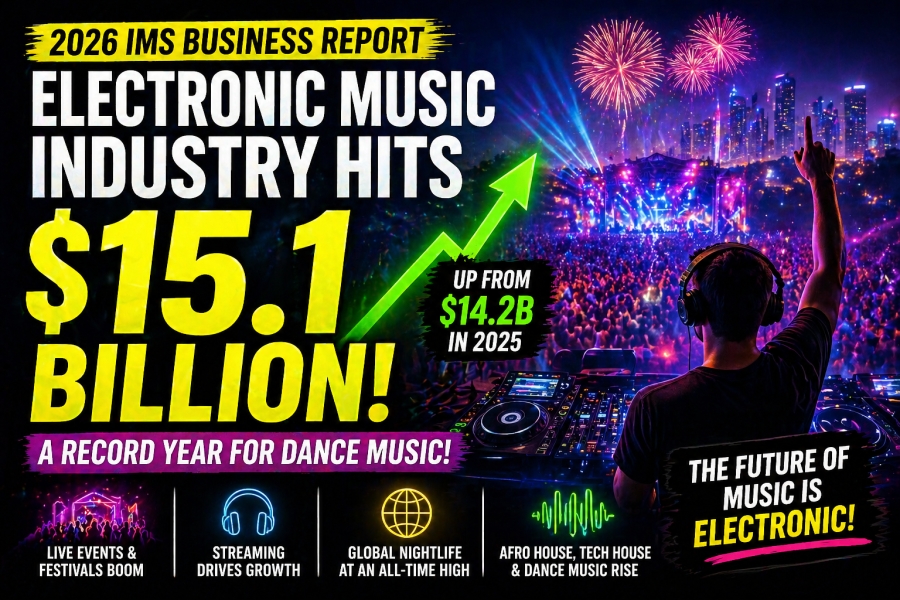
Electronic Music Industry Hits Record $15.1 Billion Valuation in 2026
The global electronic music industry has officially reached a historic milestone.
According to the 2026 IMS Business Report, the electronic music business is now valued at $15.1 billion, up from $14.2 billion the previous year. This marks another major leap for one of the fastest-growing sectors in the global music industry and confirms what artists, DJs, promoters, and producers have been feeling for years:
Electronic music is not just thriving—it is leading.
From sold-out festivals and club culture to streaming dominance and brand partnerships, electronic music continues to shape global nightlife, youth culture, and the future of music consumption.
For producers working in Afro House, tech house, melodic house, festival EDM, and club-focused genres, this report sends a very clear message:
The opportunity is bigger than ever.
Let’s break down what this $15.1 billion valuation means, what is driving the growth, and why 2026 could be one of the most important years electronic music has ever seen.
What Is the IMS Business Report?
The IMS Business Report is one of the most respected annual reports in dance and electronic music.
Published during International Music Summit (IMS) in Ibiza, the report tracks the global financial health of the electronic music ecosystem, including:
- Streaming revenue
- Live events and festivals
- DJ culture
- Labels and publishing
- Technology platforms
- Music production tools
- Clubbing and nightlife economics
- Sync licensing and brand partnerships
It acts as a major business indicator for where electronic music is heading globally.
And in 2026, the message is loud:
Dance music is now one of the strongest commercial forces in the entire music industry.
$15.1 Billion: Why This Number Matters
The jump from $14.2B to $15.1B is more than just a financial statistic.
It proves that electronic music is no longer treated as a “scene” or niche genre.
It is now one of the central engines of modern music business growth.
This valuation reflects:
- Larger festival demand
- Bigger streaming numbers
- Stronger independent label ecosystems
- Increased international touring
- More investment from major brands
- Higher creator demand for electronic production tools
It also shows that electronic music has become culturally permanent.
This is not a temporary boom.
This is infrastructure.
Live Events Are Driving the Biggest Growth
The strongest revenue driver in the report remains:
Live music
Festivals, club nights, Ibiza residencies, destination events, and global touring continue to fuel the electronic music economy more than any other sector.
Major festivals like:
- Tomorrowland
- Ultra Music Festival
- Creamfields
- Coachella Valley Music and Arts Festival
- Amsterdam Dance Event
continue to sell out quickly, while smaller boutique events are also seeing stronger attendance.
People want experiences.
They want community.
They want real-life moments.
Electronic music delivers that better than almost any other genre.
This is especially true for Afro House and tech house, where live performance energy drives fan loyalty far beyond streaming numbers.
Streaming Keeps Expanding Dance Music Globally
Streaming is another major reason for the $15.1B valuation.
Dance music is performing exceptionally well across platforms like:
- Spotify
- Apple Music
- YouTube Music
- Beatport
- SoundCloud
Why?
Because electronic music travels globally.
A great Afro House record does not need language to connect.
Rhythm is universal.
That makes electronic music highly scalable across international markets.
A producer in Brazil, South Africa, Turkey, or Ibiza can build a truly global audience without traditional gatekeepers.
That changes everything.
Afro House Is One of the Strongest Growth Areas
One of the clearest winners in 2026 is:
Afro House
This genre continues expanding rapidly across:
- Festival stages
- Luxury beach clubs
- Fashion events
- High-end nightlife spaces
- Streaming playlists
- Brand campaigns
Artists and producers blending Afro rhythms with deep melodic house structures are seeing serious global demand.
This matters because Afro House sits at the perfect intersection of:
- emotional storytelling
- premium lifestyle branding
- international club culture
- festival crossover appeal
It works equally well in underground settings and luxury mainstream environments.
That makes it incredibly valuable commercially.
For producers in this space, the market is wide open.
Tech House Still Dominates Club Culture
While Afro House is rising, tech house remains one of the strongest engines of club demand.
Its formula works:
- immediate dancefloor energy
- repeat-listening power
- DJ-friendly structure
- strong festival adaptability
From underground clubs to massive main stages, tech house continues to dominate.
It remains one of the safest and strongest genres for DJs building consistent touring careers.
Labels understand this.
Promoters understand this.
Fans definitely understand this.
Tech house may evolve sonically, but commercially, it remains incredibly strong.
Beatport and DJ Culture Still Matter
Unlike many other genres, electronic music still depends heavily on DJ ecosystems.
Platforms like Beatport remain critical because DJs drive discovery differently than playlist culture.
A single DJ set can launch:
- a new record
- a new artist
- a new subgenre
- an international touring career
That ecosystem is powerful.
DJ support still matters.
Club testing still matters.
Crowd reaction still matters.
This is why dance music often feels more community-driven than algorithm-driven.
And that is a major strength.
Brand Partnerships and Luxury Culture Are Expanding
Electronic music is increasingly connected to:
- fashion brands
- luxury hospitality
- travel experiences
- premium nightlife
- lifestyle marketing
Beach clubs in Ibiza, Dubai, Mykonos, and Tulum are not just nightlife spaces—they are business ecosystems.
Brands want access to those audiences.
Electronic music provides that access.
This means producers are no longer just selling tracks.
They are building:
- lifestyle identity
- premium positioning
- brand value
That creates entirely new income streams beyond streaming royalties.
Smart artists understand this.
Why Independent Producers Have More Opportunity Than Ever
One of the most exciting parts of the 2026 report is how much opportunity still exists for independent artists.
You no longer need:
- major label approval
- radio dependence
- mainstream pop structures
You need:
- strong music
- consistent branding
- global strategy
- community connection
Platforms like:
- TikTok
- YouTube
- SoundCloud
allow electronic artists to grow internationally from day one.
That is powerful.
Especially for producers working outside traditional music capitals.
What This Means for Emerging Artists
If you are producing electronic music in 2026, the market is telling you something important:
There is room.
But success requires more than just good tracks.
You need:
- identity
- consistency
- visual branding
- community building
- performance strategy
Music is the foundation.
But the business is bigger than the song.
That is the lesson.
What Artists Can Learn From This Growth
1. Build for Live Performance
Tracks should work in real rooms, not just headphones.
Crowd energy matters.
2. Think Globally
Electronic music travels internationally faster than most genres.
Do not think local only.
3. Premium Branding Wins
Visual identity changes perception.
Perception changes value.
4. Consistency Beats Virality
A sustainable catalog beats one lucky hit.
Always.
The Future of Electronic Music Looks Even Bigger
If 2026 is $15.1B, the bigger question is:
What happens next?
Expect continued growth in:
- Afro House
- melodic house
- Latin electronic crossover
- festival tourism
- creator economy tools
- sync licensing
- immersive nightlife experiences
Electronic music is moving deeper into mainstream culture while keeping its underground power.
That balance is rare.
And valuable.
Final Thoughts: Why This $15.1B Milestone Matters
The electronic music industry reaching a $15.1 billion valuation is not just a business headline.
It is proof of a cultural shift.
Dance music is no longer supporting the industry from the side.
It is leading it.
From streaming and festivals to luxury hospitality and global artist development, electronic music continues shaping how the modern music business works.
For producers in Afro House, tech house, and dance music, this is not just good news.
It is a signal.
A signal that the audience is growing.
The money is growing.
The demand is growing.
And the artists who understand this moment will be the ones who define the next era.
Electronic music is not waiting for the future.
It is building it right now.
