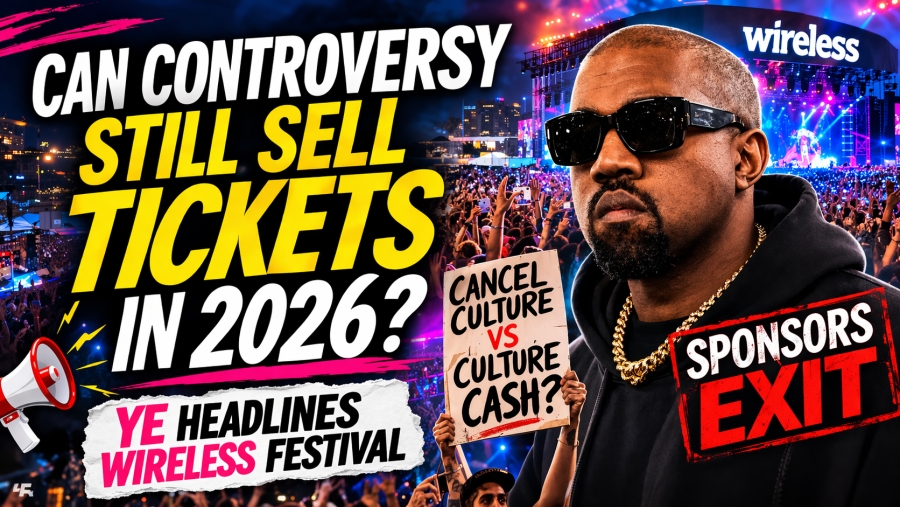
🎤 Can Controversy Still Sell Tickets in 2026?
The Wireless Festival, Kanye West, and the Battle Between Culture & Commerce
🎧 Introduction: When Headlines Become the Headliner
In 2026, controversy isn’t just part of the music industry—it is the marketing strategy.
The announcement that Kanye West (Ye) would headline Wireless Festival sparked immediate backlash. Major brands pulled sponsorship, social media erupted, and headlines dominated global news cycles.
But here’s the real question:
👉 Did it hurt ticket sales—or help them?
Because in today’s attention economy, controversy often does something unexpected:
👉 It sells.
🔥 PART 1: The Wireless Festival Fallout – Sponsors vs Spectacle

When Wireless Festival confirmed Ye as a headliner, the reaction was immediate—and divided.
💥 Sponsor Exodus
Several major brands reportedly withdrew or reconsidered their involvement. For companies, the risk wasn’t just financial—it was reputational.
In the modern era:
- Brand image = everything
- Public backlash spreads instantly
- Association with controversy can damage long-term trust
👉 For sponsors, aligning with a polarizing figure like Ye became a high-risk move.
🎟️ But Tickets? Still Selling
Despite sponsor withdrawals, ticket demand remained strong—and in some cases, surged.
Why?
Because controversy generates:
- Massive media exposure
- Social media virality
- Curiosity-driven demand
👉 People didn’t just want to attend—they wanted to see what would happen.
⚖️ The New Reality
Festivals are now balancing two opposing forces:
| Sponsors Want | Fans Want |
|---|---|
| Safety | Excitement |
| Predictability | Unpredictability |
| Clean branding | Cultural moments |
And increasingly…
👉 Fans are winning.
🧠 PART 2: Cancel Culture vs Commercial Success

The Ye controversy highlights a deeper industry tension:
👉 Does cancel culture actually cancel anything?
📱 The Illusion of Cancellation
In theory, cancel culture aims to:
- Hold public figures accountable
- Reduce harmful influence
- Push brands to take a stand
But in practice?
It often leads to:
- Increased visibility
- More streaming numbers
- Higher ticket demand
👉 Controversy fuels attention—and attention fuels revenue.
📊 The Attention Economy
In 2026, attention is the most valuable currency.
Artists don’t just compete on music anymore—they compete on:
- Headlines
- Virality
- Cultural relevance
And controversy delivers all three instantly.
👉 A trending scandal can outperform a marketing campaign overnight.
🎤 Ye as the Ultimate Case Study
Kanye West has built a career not just on music, but on cultural disruption.
Love him or hate him:
- He dominates conversations
- He commands attention
- He drives engagement
And in the modern music economy:
👉 Engagement = revenue
💸 PART 3: The Business of Controversy in Live Music
So what does all of this mean for the business of music?
🎟️ 1. Controversy Drives Ticket Sales
Like it or not:
- Polarizing artists create urgency
- Fans fear missing out on “historic moments”
- Events become cultural spectacles
👉 Controversy transforms concerts into must-see events.
🏢 2. Sponsors Are Becoming More Cautious
Brands are increasingly:
- Risk-averse
- Reputation-focused
- Socially accountable
This creates a growing divide:
- Artists push boundaries
- Brands pull back
👉 Result: Festivals must rely more on ticket revenue than sponsorships.
📉 3. A New Revenue Model Is Emerging
Traditionally:
- Festivals relied heavily on brand partnerships
Now:
- Direct-to-consumer revenue (tickets, VIP experiences) is becoming dominant
👉 Fans—not brands—are becoming the primary financial driver.
⚠️ 4. The Risk Factor
This strategy isn’t without danger.
If controversy:
- Crosses ethical lines
- Leads to legal issues
- Alienates audiences
👉 It can backfire massively.
🌍 The Bigger Picture: A Cultural Shift
The Ye and Wireless Festival situation reflects a broader shift in society:
- Audiences are more divided than ever
- Social media amplifies every opinion
- Outrage spreads faster than music
But at the same time:
👉 People are more curious, engaged, and reactive.
🔮 The Future of Controversy in Music
Looking ahead, we can expect:
🚀 More Polarizing Lineups
Festivals may intentionally book controversial artists to drive attention
📊 Data-Driven Risk Decisions
Promoters will analyze whether controversy increases ROI
⚖️ Brand vs Culture Divide
Sponsors and audiences will continue pulling in different directions
💡 Final Verdict: Can Controversy Still Sell Tickets?
👉 Yes—but with conditions.
Controversy works when it:
- Sparks conversation
- Drives curiosity
- Feels culturally relevant
But fails when it:
- Becomes harmful
- Feels forced
- Crosses ethical boundaries
🎤 Conclusion: The New Rules of the Industry
The music industry in 2026 is no longer just about sound—it’s about attention, emotion, and impact.
The Ye controversy proves one thing:
👉 Music is no longer just heard—it’s experienced, debated, and consumed as culture.
And in this new world:
👉 Controversy isn’t a risk.
👉 It’s a strategy.
