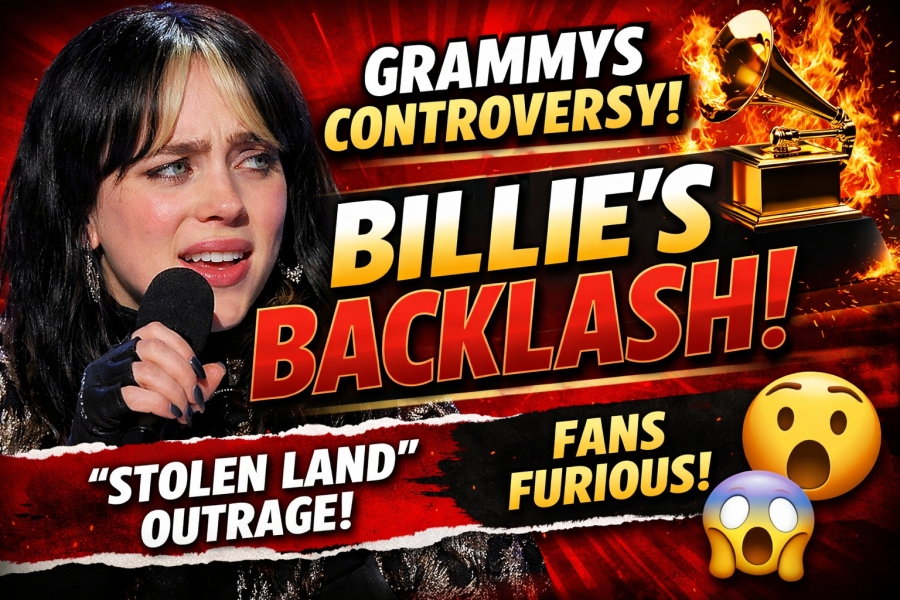
Billie Eilish Backlash After “Stolen Land” Grammys Speech: What Happened and Why It Matters
Billie Eilish’s 2026 Grammys acceptance speech stirred intense reactions — not just applause on stage, but a major public backlash that quickly spread across social media, news outlets, and cultural conversations. What began as a political statement during a high-profile awards moment has turned into one of the most widely debated celebrity controversies of the year.
In this post, we’ll unpack:
-
What Billie Eilish said at the Grammys
-
How the public and media reacted
-
Why has the backlash been so strong
-
How does this reflect broader tensions around celebrity activism
Let’s dive in.
What Billie Eilish Actually Said at the 2026 Grammys
On February 2, 2026, Billie Eilish won the Song of the Year award for her song “Wildflower” at the 68th Grammy Awards.
During her acceptance speech, she moved beyond a traditional thank-you and used her platform to address political issues — specifically immigration and the role of ICE (U.S. Immigration and Customs Enforcement). Her key comments included phrases such as:
“No one is illegal on stolen land.”
“It’s really hard to know what to say and what to do right now… Our voices really do matter.”
Ending her remarks with a censored but explicit critique of ICE.
Billie and her brother Finneas also wore “ICE OUT” pins at the ceremony, signaling solidarity with immigrant rights advocates.
This was part of a larger trend at the 2026 Grammys, where several artists used their speeches to bring attention to social issues, particularly immigration enforcement policies.
Immediate Public Reaction: Social Media Erupts
Just hours after the ceremony, clips and quotes from Eilish’s speech began trending online. Fans and critics alike reacted — but not always positively.
Viral Mockery and Criticism
Some social media users responded with sarcasm or mockery. For example, an Australian influencer joked about moving into Eilish’s multimillion-dollar mansion “because no human being is illegal on stolen land,” referencing her speech and applying it to property rights.
Others criticized Eilish for being out of touch, with comments like “Billie Eilish said ‘F-ck ICE’ but lives in a $14 million mansion.”
On Reddit and other platforms, people debated whether her statement made logical sense and whether it was appropriate for a music awards show. The quote “No one is illegal on stolen land” became a flashpoint, with some applauding and others dismissing it as oversimplified or misguided.
This kind of polarized social media activity helped push the controversy into mainstream news coverage. Google Trends across the U.S. and Europe showed spikes in searches for “Billie Eilish Grammys speech.” (While CNN doesn’t release its internal trends publicly, multiple news outlets tracked rising interest in the story.)
Native American Tribe Weighs In
One of the most news-covered aspects of the backlash came from the Tongva Tribe, whose ancestral land includes the Los Angeles area, where Billie Eilish owns a home.
Within days of the speech:
-
Online users pointed out that Eilish’s multimillion-dollar Los Angeles home is built on land historically inhabited by the Tongva people.
-
News outlets cited comments from a Tongva representative stressing that while Eilish has yet to contact the tribe, they hoped future references to “stolen land” would explicitly acknowledge indigenous territories.
This added another layer to the discussion: critics accused Eilish of hypocrisy or performative activism — voicing empathy for marginalized people while not engaging directly with the indigenous community tied to her own property.
“Hypocrisy” Claims and Celebrity Activism
Across conservative and centrist news outlets, several commentators labeled the speech hypocritical. Some of the key themes in this criticism include:
-
Questioning why Eilish would critique ICE while living on what critics called “stolen land.”
-
Highlighting the contrast between her wealth and the struggles of the populations she referenced.
-
Public figures like Elon Musk called Eilish a “hypocrite” on social media after her speech, reigniting debates about celebrity activism.
Critics argue that making a political statement without corresponding action — such as outreach to indigenous communities — weakens the moral force of the message.
Supporters of Eilish, on the other hand, argue that using a global stage to raise awareness is valuable in itself, even if imperfect.
Why This Matters: Celebrity Voices and Political Speech
Billie Eilish’s Grammys comments are not unique in the sense that artists have long used awards shows to make political statements.
What is notable about this moment is the speed and intensity of the backlash:
-
It spread from entertainment outlets into political discourse.
-
It prompted responses not just from fans but from news commentators and leaders of indigenous groups.
-
It sparked campaigns, real and satirical, such as one aimed at relocating to her home in response to her comments.
This reveals a few broader cultural currents:
-
Polarization around immigration policy
-
Heightened scrutiny of celebrity politics
-
Growing public awareness of indigenous history and land rights
The convergence of these issues at one awards show illustrates how pop culture and political discourse are now deeply intertwined.
Proponents: Why Fans Defend Her Speech
While the backlash has been intense in some quarters, it’s important to note that many fans and commentators have defended Billie Eilish’s speech.
Supporters highlight:
-
Her intention to support immigrant rights and human dignity
-
The long history of artists raising political issues at public events
-
The fact that other musicians at the same show also protested ICE and immigration enforcement policies
-
That many awards shows and public figures historically avoided political engagement until recent years
For some, the uproar says more about cultural polarization than anything Eilish did wrong.
Broader Conversation: What the Debate Says About Society
The controversy reflects larger societal debates that go far beyond one Grammy speech:
Immigration and ICE
Billie’s critique of ICE tapped into ongoing tension around U.S. immigration enforcement — especially actions taken in recent years that have spurred nationwide protests. Whether one agrees with her position or not, the topic is already deeply polarizing.
Indigenous History and Land Rights
The discussion about “stolen land” also brought indigenous land rights into the spotlight — forcing many people who might not have engaged with that issue to confront it.
This is part of a broader cultural reckoning over how history is remembered and who gets to tell it.
Celebrity Activism
Finally, this event illustrates a conflict at the heart of modern celebrity culture:
-
Should artists use their platforms for activism?
-
When they do, are they subject to different standards than traditional political figures?
-
Is there a responsibility to follow words with action?
These are questions that extend far beyond one singer or one awards show.
Conclusion: A Moment That Sparked a Broader Debate
Billie Eilish’s Grammy acceptance speech was intended as a statement on injustice and solidarity. Instead, it became one of the most widely discussed and polarizing celebrity moments in recent years — generating both applause and backlash.
Whether you agree with her or not, this controversy reveals more about our cultural moment than about one artist. In an era where celebrity platforms and political discourse intersect more than ever, every word can become a flashpoint — and public reaction can be swift, intense, and unpredictable.
What’s clear is that this conversation isn’t going away anytime soon.
