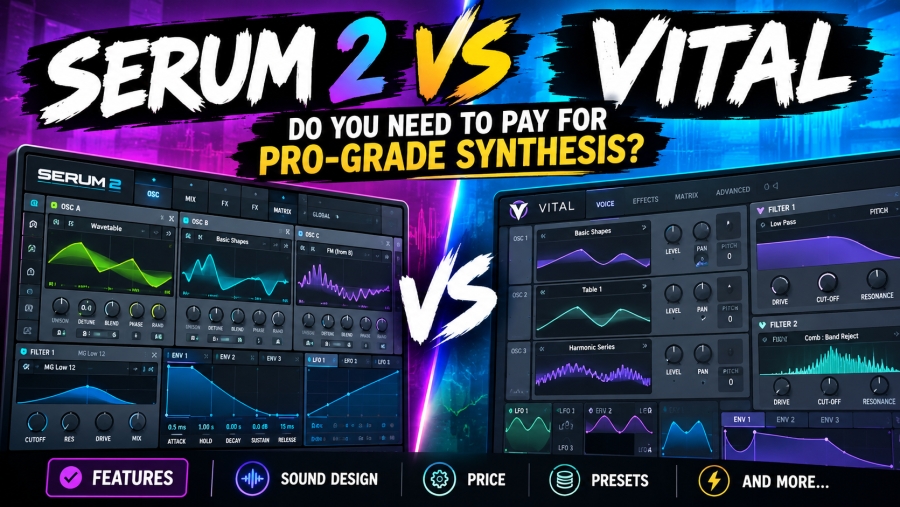
Serum 2 vs Vital: Do You Need to Pay for Pro-Grade Synthesis?
For years, Xfer Records Serum has been one of the defining soft synths of modern electronic music. Its combination of visual wavetable editing, powerful modulation, clean sound and an enormous preset ecosystem helped make it a standard production tool.
Then came Vital.
Released by Matt Tytel in 2020, Vital immediately challenged the idea that you needed to spend serious money to get professional-level wavetable synthesis. Its free version wasn't a crippled demo—it offered the full synthesis engine, with the main limitation being the amount of included factory content.
Now the comparison is more interesting than ever because Serum 2 has dramatically expanded what Xfer's instrument can do.
Serum 2 currently costs $249 USD from Xfer Records and includes lifetime free updates, while Vital continues to offer a free Basic tier with the full synth, alongside paid tiers that primarily add presets, wavetables and additional content.
So the big question is simple: do you actually need to pay for Serum 2 to get pro-grade synthesis, or can Vital handle almost everything you throw at it?
Serum 2 vs Vital: The Basic Difference
At first glance, Serum 2 and Vital seem remarkably similar.
Both are visual wavetable synthesizers. Both allow extensive modulation. Both let you create and manipulate complex waveforms, build evolving pads, aggressive basses, modern leads and detailed electronic textures.
Both also make sound design unusually visual.
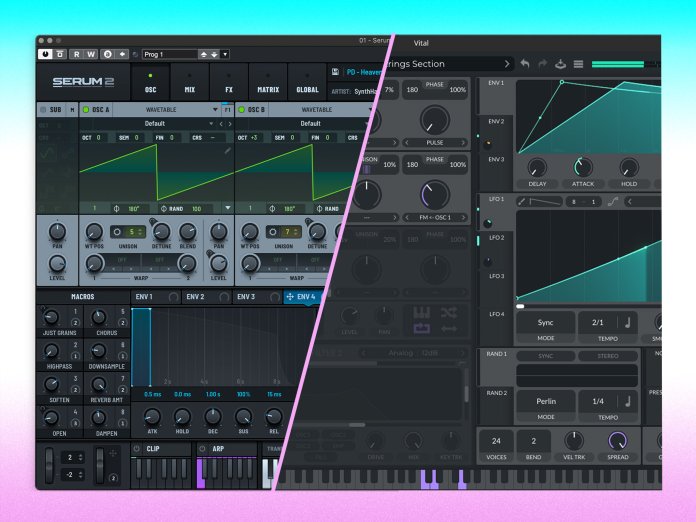
Vital's interface displays animated waveforms, filter responses, oscilloscopes and spectrograms, while its modulation system uses a drag-and-drop workflow with visual feedback.
Serum established much of this workflow as a benchmark, and Serum 2 expands it considerably by turning the instrument into a broader hybrid synthesizer.
The fundamental difference is therefore not really professional versus amateur.
It's more accurately focused wavetable synthesis versus a much broader synthesis and sampling environment.
And that's an important distinction.
What You Get With Vital for Free
Vital's biggest selling point remains its free version.
The Vital Basic edition costs nothing and includes the complete synthesizer engine, 75 presets and 25 wavetables. Vital's paid Plus and Pro versions don't unlock a fundamentally different synthesizer—they add more factory content and additional perks.
That means someone downloading Vital Basic isn't receiving a watered-down version of the instrument.
The actual synthesis capabilities are there.
Vital includes three wavetable oscillators, extensive modulation, filters, effects, MPE support, audio-rate modulation, microtonal support and its distinctive spectral-warping technology.
Its spectral warping system is particularly important. Rather than simply scanning through a wavetable, Vital can manipulate the harmonic content of a waveform to create radically different timbres.
Vital can also turn samples into wavetables using its pitch-splice or vocode conversion tools, create wavetables with its built-in editor and generate wavetables from text.
For anyone learning synthesis, that's a huge amount of functionality before spending a single dollar.
Serum 2 Is Much More Than a Wavetable Synth
This is where the comparison changes.
Serum 2 retains the classic wavetable workflow but adds several new oscillator types that significantly expand its sonic possibilities.
Xfer lists wavetable, multisample, sample, granular and spectral oscillators as part of Serum 2.
The multisample oscillator can work with recorded instruments including orchestral sounds, choirs, pianos and guitars. Serum 2 can also work with SFZ multisample files.
The dedicated sample oscillator adds looping, slicing, modulation and additional sample-processing options.
Then there's the granular oscillator, which can transform sample material into evolving clouds of sound.
And the spectral oscillator allows real-time resynthesis at the harmonic level.
This is arguably the biggest reason to consider Serum 2.
Vital is extraordinarily capable at wavetable synthesis, but Serum 2 is no longer just competing as another wavetable synth. It's increasingly becoming a hybrid sound-design environment.
Wavetable Editing: Both Are Extremely Capable
One of the biggest misconceptions about Vital is that it lacks serious wavetable editing.
It doesn't.
Vital includes a built-in wavetable editor and lets users create their own wavetables from scratch. Its sample-to-wavetable tools can also convert external audio into usable wavetable material.
This makes Vital considerably more powerful than its "free Serum alternative" reputation sometimes suggests.
Serum 2, however, remains exceptionally deep when it comes to manipulating wavetables.
Xfer's system supports waveform manipulation, filtering, FM, phase distortion, ring modulation, distortion and multiple warp approaches. Serum 2 also adds smooth interpolation and dual warp capabilities to its main oscillator architecture.
For traditional wavetable sound design, the two instruments are therefore much closer than their prices might suggest.
If you're mainly making supersaws, basses, plucks, leads, pads and evolving digital textures, Vital already provides the fundamental tools.
Modulation: Vital Has Some Serious Tricks
Modulation is one of Vital's strongest areas.
Its interface allows you to drag modulation sources directly onto parameters and preview the effect before committing the connection.
Vital also offers custom LFO shapes, envelopes, randomized modulation sources, stereo modulation and modulation remapping.
The stereo modulation feature is particularly useful for creating movement across the stereo field. Instead of sending exactly the same modulation signal to both channels, Vital can introduce left/right differences.
For experimental electronic music, ambient textures and evolving patches, these tools can be incredibly effective.
Vital also supports MPE, aftertouch and velocity-based modulation, making it suitable for expressive hardware controllers.
In other words, buying Serum 2 isn't automatically going to make your modulation more musical.
A producer who understands Vital's modulation system can create extraordinarily complex sounds without ever touching Serum.
Where Serum 2 Pulls Ahead: Effects and Signal Routing
Serum 2's expanded architecture becomes increasingly valuable once you move beyond the oscillator section.
The synth includes flexible effects routing and additional processing options, while its expanded effect architecture gives sound designers more ways to treat different elements of a patch.
According to MusicTech's comparison, Serum 2 has 12 effects compared with nine in Vital, and includes features such as convolution reverb and frequency shifting.
The ability to approach effects routing more like a miniature production environment can reduce the need for external plugins.
This matters when you're creating a complex bass, cinematic texture or evolving sequence where distortion, delay, filtering and reverb all need to interact dynamically with the source material.
Vital still has a very capable effects section.
But Serum 2 offers more room to build elaborate internal signal chains.
Serum 2's Granular and Spectral Engines Change the Equation
If you only use wavetable synthesis, Vital can take you a very long way.
But Serum 2's newer engines open completely different creative doors.
Granular synthesis lets you take sample material and break it into small pieces you can rearrange, scan, and manipulate.
The spectral oscillator takes that concept into the frequency domain, allowing harmonic resynthesis and manipulation of samples.
This means Serum 2 can move from traditional synthesized sounds into textures that sit somewhere between synthesis, sampling and sound design.
That doesn't necessarily make every Serum 2 patch better.
It simply means the instrument offers more synthesis techniques.
If your work frequently involves cinematic sound design, experimental electronic music, game audio, ambient textures or heavily processed samples, those additional engines can become genuinely useful.
Presets: Serum Has a Huge Ecosystem
Another major difference isn't actually inside the synth.
It's outside it.
Serum has spent more than a decade becoming a standard format for commercial sound designers and preset developers. That has created an enormous ecosystem of Serum-compatible sounds.
Serum 2 itself currently ships with more than 626 presets and 288 wavetables, according to Xfer Records.
Vital Basic, by comparison, includes 75 presets and 25 wavetables. Vital Pro increases that to more than 400 presets and 150 wavetables.
Of course, neither number tells the entire story.
Thousands of free Vital patches and wavetables are available from the wider producer community, and you can make your own.
But Serum's commercial preset market is a major reason it remains attractive to producers who want to purchase sounds, reverse-engineer professional patches or exchange projects with other producers.
If you're regularly collaborating with people who use Serum, compatibility can also become a practical consideration.
CPU, Workflow and Your Actual Computer
Another factor worth considering is CPU usage.
Both instruments can become demanding when you start stacking voices, unison, modulation, effects and complex processing.
Vital's developers have specifically built CPU optimizations into its oscillator architecture, including SSE optimizations intended to keep unison relatively efficient.
Serum 2's expanded architecture, meanwhile, gives you more processing possibilities but can also encourage more complicated patches.
The real-world result depends heavily on your DAW, buffer settings, project size, patch design and how many instances you're running.
A synth that looks more powerful on paper isn't necessarily better for a project containing 30 instances.
Sometimes the most useful instrument is simply the one that gets the sound you need with fewer complications.
Platform Support Is Another Difference
Vital has an interesting advantage here.
The current version officially supports Windows, macOS, and Ubuntu Linux.
Serum 2 supports Windows and macOS and is available as VST3, AU, and AAX.
That AAX support can matter for producers working in Pro Tools.
For most Ableton Live, FL Studio, Logic Pro, Cubase and similar workflows, both can fit comfortably into a modern production setup, although exact plugin formats depend on the DAW and operating system.
So, Does Vital Really Sound as Good as Serum 2?
This is probably the most important question.
The answer is that professional results do not require Serum 2.
A skilled producer can create commercial-quality basses, leads, pads, plucks, effects, and synth textures using Vital.
The quality of a finished track is not determined by whether the synth cost $0 or $249.
Sound selection, arrangement, MIDI performance, processing, mixing, and production decisions matter enormously.
And because Vital gives you such deep access to its synthesis engine, the free version can serve as a serious production instrument rather than merely a learning tool.
Where Serum 2 becomes more compelling is when you specifically need what it adds.
What Are You Actually Paying for With Serum 2?
The $249 price isn't simply paying for a better-sounding wavetable oscillator.
You're paying for a larger overall instrument.
You're getting multiple oscillator architectures, multisampling, granular synthesis, spectral processing, extensive wavetable tools, a large factory library, expanded effects and routing, plus a mature third-party ecosystem.
You're also getting a product that Xfer describes as receiving lifetime free updates. Serum 2 was also released as a free upgrade for existing Serum 1 owners.
That makes the value proposition different for an existing Serum user than it is for someone buying their first serious soft synth.
Who Should Stick With Vital?
Vital makes enormous sense if you're:
- Learning synthesis
- Producing music on a tight budget
- Mainly interested in wavetable synthesis
- Making EDM, house, techno, trap, pop, ambient or experimental music
- Comfortable creating your own patches
- Interested in spectral warping
- Working on Linux
- Already have samplers and granular instruments elsewhere
For those workflows, the free Vital Basic edition can provide an astonishing amount of creative power.
And because the full synthesis engine is included in the free version, upgrading isn't something you need to do just to unlock "professional" sound quality.
Who Should Consider Serum 2?
Serum 2 becomes particularly interesting if you:
- Want granular synthesis inside the same instrument
- Need spectral resynthesis
- Want multisampled instruments
- Regularly manipulate samples inside your synth
- Want a huge factory wavetable and preset library
- Buy commercial Serum sound banks
- Collaborate with Serum users
- Need AAX support
- Want extensive internal effects and routing
- Prefer Serum's workflow and interface
In these situations, you're not paying simply for the word "Serum."
You're paying for a significantly broader instrument.
Serum 2 vs Vital: The Real Verdict
The most useful conclusion isn't that one synth replaces the other.
It's that Vital makes professional wavetable synthesis accessible without requiring a purchase, while Serum 2 justifies its price by going considerably beyond conventional wavetable synthesis.
Vital's free version already includes the full synthesizer engine, advanced modulation, spectral warping, custom wavetable creation, MPE, and a substantial range of sound-design tools.
Serum 2, meanwhile, expands the concept into a much more comprehensive hybrid instrument with wavetable, sample, multisample, granular, and spectral oscillator technologies, alongside extensive effects and routing.
So do you need to pay for pro-grade synthesis?
No.
You can absolutely make professional music with Vital.
But if you're looking for a single instrument that combines wavetable synthesis with granular, spectral, sampling and multisampling capabilities—and you value Serum's enormous preset ecosystem—Serum 2 offers substantially more functionality for its $249 asking price.
For many producers, the smartest approach may actually be to use both.
Start with Vital. Learn synthesis. Build patches. Understand oscillators, filters, envelopes and modulation.
Then, if you eventually encounter a specific limitation, Serum 2 gives you a clear upgrade path into a much larger sound-design environment.
In 2026, the interesting question isn't whether Vital is "good enough."
It's whether the additional capabilities of Serum 2 are capabilities you will actually use.
